 Coinmarketcap
 rankings: Market Cap and Eligibility Rules
Coinmarketcap rankings compare cryptoassets by circulating market capitalization, subject to supply verification and eligibility rules. A larger displayed valuation does not always secure a higher position because assets can occupy different ranking tiers. The useful distinction is between an asset’s calculated market size and its eligibility for the main standings. Reading both together helps explain apparent ordering anomalies without treating a position as a judgment about investment quality.
Updated -
In short: A market-cap comparison needs matching supply definitions, while ranking eligibility determines which assets can compete for the same positions.
Circulating value behind placement
Circulating market capitalization measures the valuation of tokens counted as publicly circulating, making the supply definition central to any comparison between ranked assets. Circulating market capitalization equals the reference price multiplied by circulating supply. Fully diluted valuation uses maximum supply instead. Substituting maximum supply for circulating supply changes the question the calculation answers.
The first distinction is therefore the field being compared. A circulating valuation and a fully diluted valuation cannot explain relative placement on equal terms. Unit price alone is also insufficient: the quantity of circulating tokens matters just as directly. This calculation explains market size, while eligibility determines how the ranking uses it.
Why can a larger market cap have a lower rank?
Ranking tiers can place an asset below another with a smaller market cap because eligibility imposes additional conditions beyond the valuation calculation.
Top 200 eligibility
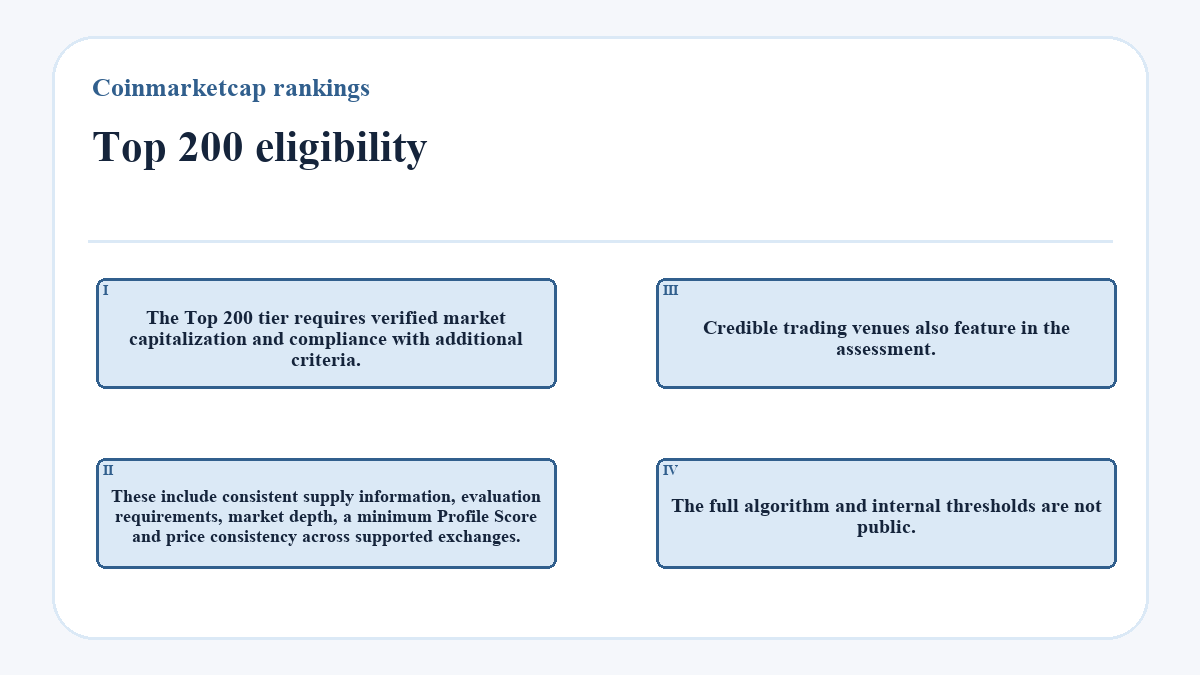
The Top 200 tier requires verified market capitalization and compliance with additional criteria. These include consistent supply information, evaluation requirements, market depth, a minimum Profile Score and price consistency across supported exchanges. Credible trading venues also feature in the assessment. The full algorithm and internal thresholds are not public.
Other ranking categories
Assets with verified capitalization can qualify for positions 201 onward without satisfying every Top 200 requirement. Assets without verified capitalization occupy an unranked category ordered by 24-hour trading volume. Rehypothecated assets have a separate tier. These distinctions explain why sorting every displayed capitalization together may produce a different order.
Supply verification and project figures
Supply verification establishes which holdings enter the ranking calculation, while a project’s own reported supply can remain visible without changing its rank.
Verified circulating supply
Verification examines distribution information, relevant addresses and supporting blockchain data. Locked holdings, insider allocations and tokens unavailable for public sale are generally excluded. An unlocked allocation does not automatically count as publicly circulating. Trading activity and liquidity also inform the assessment, alongside the ability to substantiate the submitted information.
Self-reported circulating supply
Self-reported figures let a project present its own supply calculation alongside verified data. They have no ranking implications by themselves. A disagreement between the fields therefore requires attention to their definitions; selecting the larger figure does not establish an error in the standings.
Profile completeness and trading conditions
Profile Score measures the completeness and freshness of project information, adding a disclosure consideration to the market conditions relevant to ranking eligibility. Supply information and token unlock schedules carry more weight than basic social links. Information can lose freshness as it ages, so a previously complete profile is not permanently current.
Disclosure quality and trading conditions answer different questions. A detailed profile explains the asset, while market depth concerns the available buying and selling interest. Price consistency addresses agreement between trading venues. None of these observations alone establishes that a token will retain its value.
Wrapped and staked assets in separate tiers
Wrapped and staked representations can repeat exposure to an underlying asset, so their placement requires different treatment from an unrestricted ranking of every displayed capitalization.
The separate category for rehypothecated cryptoassets addresses both repeated entries and double-counting. Here, the category includes wrapped, staked and restaked representations. Their relationship to underlying assets matters when interpreting aggregate market size: adding both representations indiscriminately can count overlapping economic exposure.
A separate ranking position does not, by itself, measure the reliability of the wrapping or staking mechanism.
A worked reconciliation of displayed market cap
A market-cap reconciliation starts with the same price, circulating supply definition and observation time, then tests whether their product matches the displayed valuation.
Consider an entirely hypothetical asset with a reference price of 3.17 currency units per token and verified circulating supply of 1,247 tokens. Assume its displayed circulating market cap is 3,952.99 currency units. All these changing inputs belong only to this example. The calculation is 3.17 × 1,247 = 3,952.99, so the displayed valuation reconciles exactly.
If this asset’s placement seems unexpectedly low, repeating the multiplication cannot resolve its tier. Its supply status and ranking category remain separate inputs to the interpretation.
The completed check establishes arithmetic consistency at that observation time. A subsequent price or supply update requires fresh inputs. The reference price values each token in the calculation; it does not establish the execution price or total cost of buying a position. No transaction is necessary to perform this comparison.
Rank movement and changing inputs
Relative placement can change when an asset’s valuation changes, when competing assets move or when its eligibility changes, so rank alone cannot identify the cause.
The reference price combines market-pair prices using volume weighting. Some prices are excluded when trading restrictions undermine their representativeness or when they are significant outliers. Consequently, a single exchange quotation need not explain the displayed valuation.
Price tracking provides one part of the explanation. A comparison record also needs the circulating supply figure and the ranking category used at each observation. Otherwise, a change attributed to demand might instead reflect a revised supply calculation or different eligibility.
Rank is relative: an unchanged valuation can lose places when other eligible assets grow.
Market size versus executable liquidity
Market-cap rankings suit comparisons of circulating valuation, while available market depth better addresses whether a particular trade can execute near its expected price.
Liquidity concerns the buying and selling interest available in a market. Slippage is the difference between an expected execution price and the price obtained. Order size and order-book depth affect that difference, so a high market-cap position cannot establish the cost of a particular transaction.
A shortlist based on market size therefore answers a narrower question than a trading decision. Comparing liquidity becomes necessary when the task changes to execution. If the intended order size or available depth changes, the same asset ranking can accompany a different execution outcome.
Coinmarketcap rankings: what people ask
-
Can two adjacent ranks represent very different market sizes?
- Adjacent ranks do not imply similar market capitalizations. Rank expresses order, not the distance between values. Compare the underlying capitalizations to assess the gap, keeping their supply basis and observation time consistent. A one-place difference supplies no fixed percentage difference.
-
What does a missing market-cap figure mean for a comparison?
- A missing market-cap figure leaves the asset’s circulating valuation unresolved in that comparison. It should not be entered as zero or replaced silently with a self-reported value. Coinmarketcap distinguishes assets without verified capitalization from those eligible for its verified market-cap ranking tiers.
-
Does a verified listing guarantee verified circulating supply?
- A verified listing does not automatically establish verified circulating supply. Listing verification concerns the reviewed page and the origin of its information. Supply verification separately assesses the quantity eligible for the calculation. The listing label also does not guarantee project quality.
-
How do exchange rankings differ from cryptoasset rankings?
- Exchange rankings assess trading venues through multiple factors rather than ordering them by a token’s circulating market capitalization. Inputs include liquidity, traffic, trading volume and qualitative considerations. An exchange’s position and an asset’s position therefore describe different subjects and cannot be compared directly.
-
Can a project pay to obtain a higher market-cap rank?
- Coinmarketcap prohibits payments intended to manipulate rankings or publish inaccurate information. Its rules also reject bribery and warn about intermediaries promising guaranteed outcomes through supposed insiders. A paid promise of a particular rank does not establish that the asset meets the eligibility requirements.
-
Are tokens held in masternodes always excluded from circulating supply?
- Tokens held in masternodes receive a case-by-case supply assessment. Relevant considerations include ownership, distribution and lock-up periods. The presence of staking alone is therefore insufficient to infer the treatment of every balance; the allocation’s actual conditions matter.
-
Where can a project request a correction to verified supply?
- A project can request a supply correction through Coinmarketcap’s support request form by selecting the option to update an existing cryptoasset’s verified supply figures. Supporting information must substantiate the requested change and satisfy the supply methodology. Repeated duplicate submissions can delay processing, and submitting a correction does not itself establish a new rank.