 Coinmarketcap
 - Crypto Prices and Market Cap Comparisons
Coinmarketcap brings cryptocurrency prices, supply figures and trading activity together so readers can compare assets beyond their unit price. Market capitalization combines price with circulating supply, the estimated quantity in public hands. A low token price alone therefore says little about an asset’s relative valuation. Asset pages also provide charts and market listings, while watchlists and portfolios organize ongoing tracking. The distinction between a market estimate, a holdings record and an executable trade matters throughout these tools. Each answers a different question, and none makes a displayed price a promise of what a particular transaction will receive.
Updated -
Bottom line: Market cap puts token prices in context, while liquidity and supply definitions explain what the displayed valuation can tell you.
Unit price and circulating market cap
A token’s unit price describes one unit, while market cap measures the valuation of its circulating supply. Circulating market capitalization equals an asset’s reference price multiplied by its circulating supply. A larger supply can therefore produce a larger market cap even when each token costs less. Comparing prices alone misses that relationship. Market cap provides a common valuation measure across assets with very different quantities of tokens.
Neither measure establishes whether an asset is attractively valued. Market cap does not measure revenue, adoption or the availability of buyers. It also changes when its supply input changes, even if price stays constant. Market-cap rankings summarize relative size within their methodology; understanding the underlying figures comes before interpreting a position in the list.
Can you trade through Coinmarketcap?
Coinmarketcap supports wallet-based swaps through DEX Mode for supported tokens on Solana and BNB Smart Chain. The interface routes transactions through decentralized exchanges, where smart contracts execute swaps. Availability depends on the token, network and compatible wallet. Tokens outside the supported trading configuration can have market information or links to external trading venues without an executable swap inside the interface.
A portfolio entry has a different effect: it changes tracking records. A wallet-authorized swap can change actual token balances. Coinmarketcap does not maintain a custodial account balance for these trades, and the displayed market price is separate from the transaction quote. Network fees, underlying protocol charges and slippage affect the transaction’s outcome. Slippage means execution differs from the expected price.
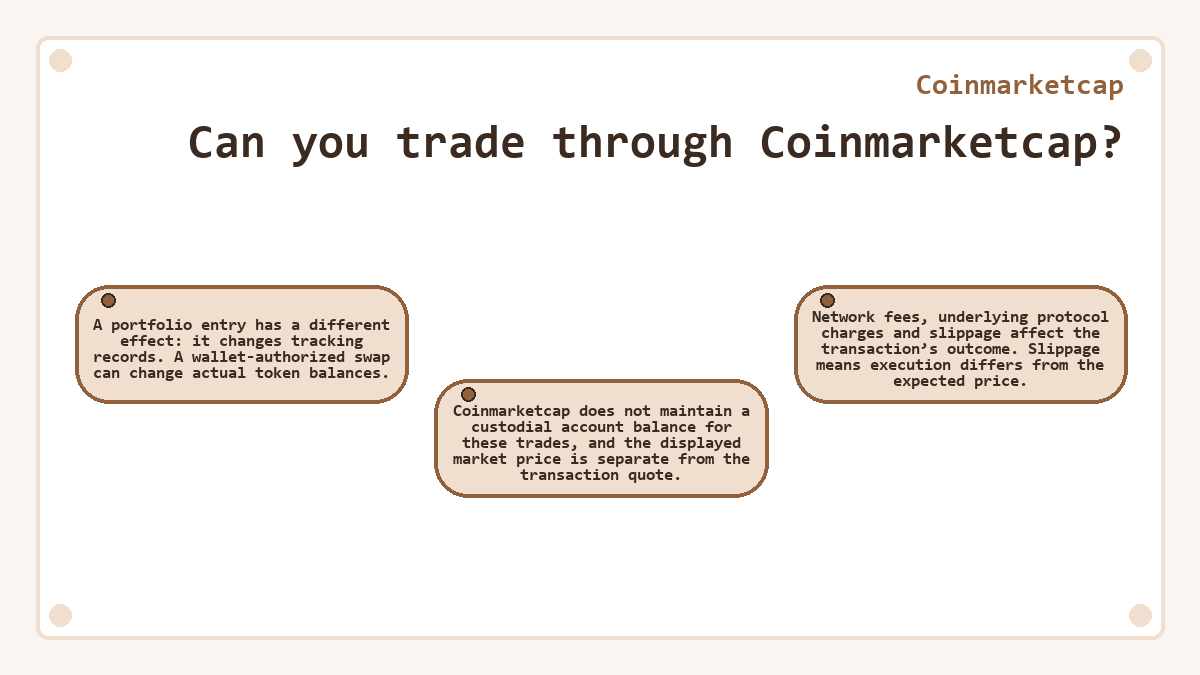
Token screening can restrict flagged assets. A token passing that screening does not eliminate smart contract or liquidity risk. A completed on-chain swap requires a new transaction to exchange assets again.
Supply definitions behind the valuation
Supply labels describe different quantities, so substituting one for another changes the meaning of a valuation.
Supply used for market cap
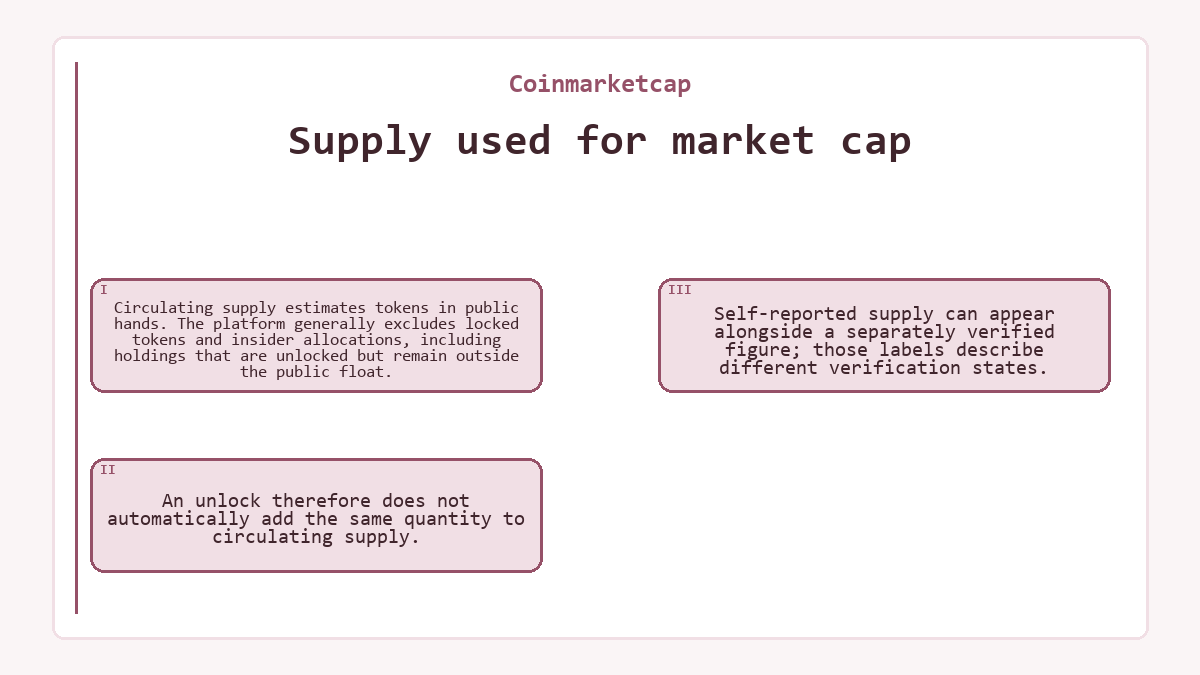
Circulating supply estimates tokens in public hands. The platform generally excludes locked tokens and insider allocations, including holdings that are unlocked but remain outside the public float. An unlock therefore does not automatically add the same quantity to circulating supply. Self-reported supply can appear alongside a separately verified figure; those labels describe different verification states.
Broader supply measures
Total supply and maximum supply address existing issuance and the estimated issuance ceiling. They answer different questions from circulating supply.
Tokens already created
Total supply counts existing tokens after verifiable burns. It can include locked holdings excluded from circulation. Multiplying this quantity by price produces a valuation of issued supply rather than the public float.
The issuance ceiling
Fully diluted valuation, or FDV, uses maximum supply multiplied by price. It applies today’s price to that broader quantity, rather than forecasting a future price. When maximum supply is undefined or unavailable, this calculation lacks a usable ceiling.
Why can an exchange quote differ from the displayed price?
An exchange quote reflects a particular market, while the asset’s displayed reference price combines eligible market data. Coinmarketcap calculates an asset’s reference price using a volume-weighted average of eligible market-pair prices. Markets contributing more volume have more influence on that average. Outliers and prices affected by certain trading restrictions can be excluded. A quote from one venue can differ because its buyers, sellers and available liquidity differ. The comparison also changes with the quote currency and observation time. A historical last-traded price, an aggregated reference price and an order’s executable quote describe different observations, even when all concern the same asset.
Trading activity and executable liquidity
Trading volume measures activity over a period; liquidity describes how readily a market can absorb a trade. The asset-level volume figure aggregates eligible spot-market activity over the preceding 24 hours. It does not report the amount currently available at the displayed price. Repeated trading can generate substantial volume without creating equally deep buying and selling interest.
Liquidity scores assess expected slippage across different order sizes. Higher scores indicate more liquid markets under that methodology, rather than guaranteeing a specific execution price. The market-pair confidence indicator addresses another question: how credible reported volume appears against the platform’s model. A strong liquidity reading and a credible volume figure describe different properties, so one cannot substitute for the other.
A market with active trading can still have poor execution for a particular order size. Conditions at the time of the transaction determine the available price and quantity.
Watchlists and portfolio records
A watchlist follows selected assets without requiring a record of ownership. A portfolio adds holdings and transaction information so the platform can estimate value and performance. Records can come from manual entries, supported exchange connections or supported on-chain address tracking. The suitable method depends on where the holdings exist and which connections the tool supports. Manual entry does not require a wallet connection, although its accuracy depends on the information entered.
Adding a transaction to a Coinmarketcap portfolio does not execute a purchase or transfer cryptocurrency. Quantity, purchase price, transaction date and fees affect the interpretation of performance. A transfer between existing holdings also has a different meaning from a new purchase. Missing history, duplicate records or an incorrect entry can distort a portfolio total without changing the assets held elsewhere. Connecting an address also associates that address’s visible holdings and activity with the tracking service.
Historical charts and reusable data
Historical data describes an earlier observation, while a live quote describes the latest available market reading. Charts make changes easier to inspect, but their time range and sampling interval affect what remains visible. A closing-price series omits movements occurring between closes. Open, high, low and close data retains more information about each interval, although it still does not reproduce every trade. A past peak also reflects the supply and market conditions of that period.
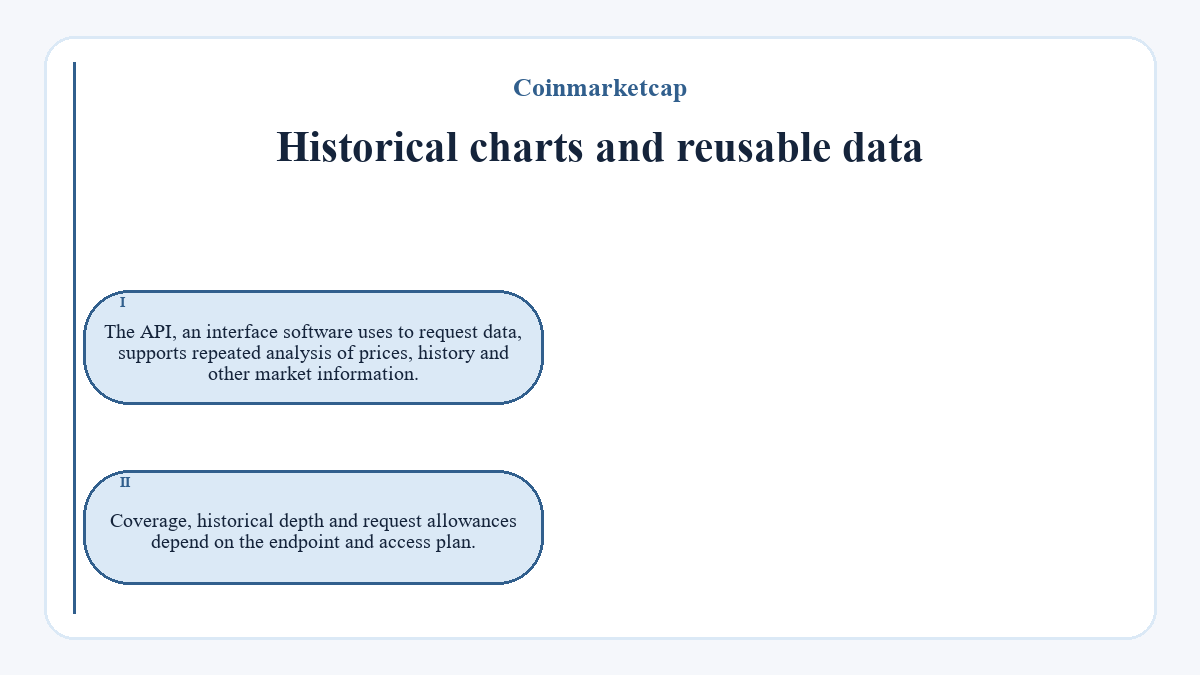
The API, an interface software uses to request data, supports repeated analysis of prices, history and other market information. Coverage, historical depth and request allowances depend on the endpoint and access plan.
Comparable records need matching asset identities, quote currencies and timestamps. Coinmarketcap reports data in UTC unless another time zone is specified. A local calendar day can therefore differ from the reporting interval.
A checklist for an incomplete market-cap comparison
If a comparison lacks verified circulating supply for one selected asset, a price-only substitute cannot complete it. Apply the same valuation basis to every asset before treating the figures as comparable.
- Confirm each selected record describes the intended asset, including the network and contract where applicable.
- Use circulating market cap for every asset in the comparison; keep FDV and total-supply valuations separate.
- Match the quote currency and observation time closely enough to avoid comparing different market readings.
- If supply is missing or self-reported, retain that status instead of entering zero or treating it as verified.
- Resume the market-cap comparison when the missing verified input becomes available; otherwise record the comparison as incomplete.
Price and volume can remain available for separate questions. Refreshing the page does not complete the comparison if verified supply is still missing or the records use different valuation bases.
Individual assets within the wider market
Aggregate market figures place individual assets within a broader collection of tracked cryptocurrencies. Total market cap combines the valuations included in the dataset. Dominance expresses an asset’s share of that aggregate, so its movement depends on both the asset and the denominator. A rising share can occur while the asset’s own price falls if the rest declines faster. Coverage and classification therefore matter when comparing aggregate figures between services or periods.
News, educational material and community discussions add context to the numerical views. They can explain terminology or identify events worth investigating, while the price, supply and liquidity fields describe measurable market conditions. An interpretation changes when those underlying conditions change: greater market cap can reflect price appreciation, additional circulating supply or both.
Quick answers about Coinmarketcap
Does a larger market cap mean more money has been invested?
Market cap measures valuation rather than cumulative money invested. Its calculation applies a reference price to circulating supply, including tokens that have not recently traded. A price change therefore revalues that entire quantity without requiring an equivalent cash inflow. Market cap also does not represent the proceeds holders could collectively receive by selling.
How can different cryptocurrencies have the same ticker?
Ticker symbols are not unique identifiers across cryptocurrency projects. Separate assets can share a symbol, and a project can change its symbol during a rebrand. Coinmarketcap assigns numeric asset IDs to distinguish records in its data systems. For tokens, the network and contract address provide additional identity information; a matching ticker alone does not establish that two records describe the same asset.
Can a portfolio screenshot prove someone made a trading profit?
A portfolio screenshot cannot independently prove a trading profit because users can manually enter transaction quantities and prices. The displayed calculation reflects those records, which may not match completed trades. Evidence of an actual result would require the underlying transaction history and relevant balances, including costs. An impressive tracker total alone establishes neither ownership nor a withdrawable balance.
Is Coinmarketcap portfolio tracking free?
Coinmarketcap provides free portfolio tracking with an account. That tracking feature is separate from API access, which has free and paid tiers with different data coverage and usage allowances. Recording holdings does not incur a blockchain transaction fee because the entry itself moves no tokens. Fees associated with an actual trade belong to that separate transaction.
What does a negative 24-hour price change measure?
A negative 24-hour price change means the reference price is below its comparison point 24 hours earlier. The percentage expresses that difference relative to the earlier price. It does not measure a holder’s personal loss unless their purchase timing and price match that comparison. A rolling 24-hour reading also differs from a change measured since local midnight.